


How do economic processes that define our experience online impact art production? How does behavioral and structural changes to the network translate to shifts in contemporary creative practice? And, significantly, can artistic attitudes impact positively on how we use the network and the network uses us?
I spent this last weekend’s traffic-time-and-oh-my-god-why-are-they-not-moving-time listening to Cory Doctorow’s podcast, Understood: Who Broke the Internet. In four episodes, Doctorow explains why the Internet has been feeling like a hot mess of signature products that consistently become worse. Coining the term Enshittification in 2022, Doctorow accurately captured the intentional downgrading and degrading of the internet, describing a multi-level process in which platforms first attract users with compelling products and services, get them hooked and locked in, and then proceed to decay the platform at the expense of users to maximize profit. Moving at a rate of one mile per hour I wondered, could we also talk about Artshittification? And if the answer is yes, is there a counter reaction to that process?
The series opens with a provocative example, demonstrating how Google, in 2019, decided to prioritize ads revenue over user experience, purposefully rolling back improvements to the search engine so more people would click more pages, making more ads visible to more users, therefore increasing Google’s bottom line. The better the system was, the less times users clicked their way around the results, meaning they saw less ads and Google made less from ads revenue.
Doctorow’s description of the monopolization of the once seemingly open-ended virtual world provides yet another reminder to how we found ourselves in the wrong timeline, in which the book 1984 feels like a blueprint more than fiction. He outlines an uncomfortable mixture of mega-corporations that run over small businesses, policymaking that harms consumers, and a very dystopian end to some very utopian beginnings.
Activist, author, blogger and journalist, Doctorow advocates for positive change, specifically in his home country of Canada, where, he says, Trump’s tariffs and the undoing of US-Canada trade agreements opened the door for Canadians to untie their bonds with American Internet policies. A change in regulations could pave the way for smaller businesses to develop tools that would undo some of the enshittification (digital locks that were set in place by the US prevent any changes to existing IP by external users/developers/companies). Such laws, according to Doctorow, allow Big Tech to maintain their grip over platforms, and purposefully discourage newcomers from offering any solutions to various issues– guaranteeing that vital platforms will remain mediocre, plagued by awkwardness that harms the user experience but pads the Big Pockets of Big Tech feudalists.
When throwing in NFTs (remember those?) and generative AI to this cultural/hyper-capital mess, enshittification gets translated to visual fields and creative production.
NFTs, or non-fungible tokens, were capitalized by producers and agencies that sprouted across the world with one goal in mind: To distribute visual digital objects to generate profit, whether those were animated media works, musical pieces or text based jpgs. Anything goes, as long as it goes to the blockchain. And yes, of course, incredible artists produced NFTs that added important chapters to art history of the twenty-first century, but many of them will not. I will come back to NFTs in a future post, but in the meantime, we can note celebrated artists like Refik Anadol made NFTs, and Mike Winklemann, AKA Beeple, almost broke the art market.
This early flux of digital images for sale that were changing the art and auction markets was about to get washed by the changing tides. Shortly thereafter, generative AI was introduced commercially on a massive scale, raising valid concerns around a constant flood of machine-generated images that would mimic the nuances of human emotional complexity without having much there. Well, other than six fingers. And just in case AI fails was exactly what you need now, I got you. And I got you.
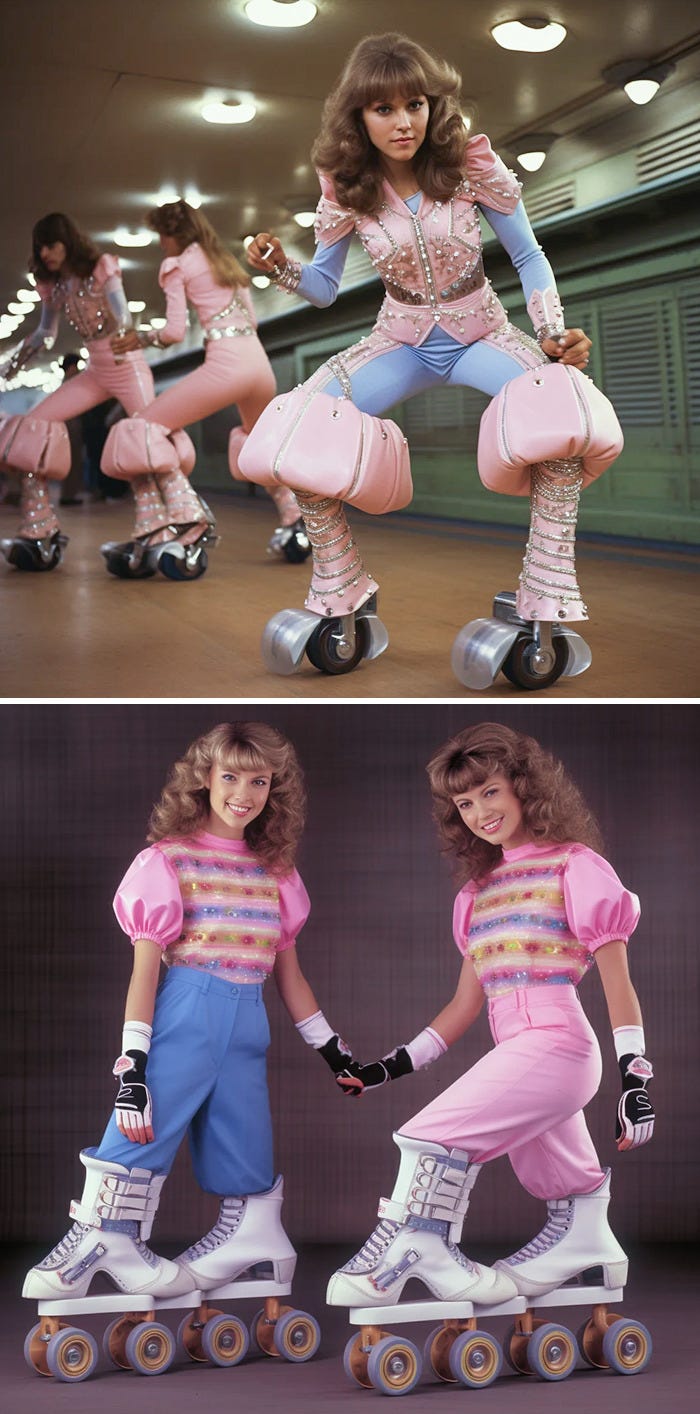
Of course, such fails are to be expected when a new product is introduced, and in the case of generative AI, the introduction period was made very public. But these fails also exposed something deeper and much more problematic.
The public distribution of images that failed to generate authentic human likeness emphasized that the creator is a machine devoid of human hand and mind. These images also highlighted how machines were trained by using images created by humans who were never asked for their permission and were never compensated for copyright. So this tool can concoct thousands of images in no time, and those frames would not be created without the labor of humans, whose work, experience and unique viewpoint became a training apparatus. The absence of the human hand, in that sense, exposed the lack of humanity. And if the goal was to create images that would look and feel like something created by humans, then it generated a far from excellent result.
The result is a tsunami of images flooding our networks, affectively changing the way we consume and read images. This flood, much like in Doctorow’s enshittification, does not halt to consider the impact of its own waves. It keeps going at our expense, while locking us in to services we cannot not use. Google’s search engine is now AI driven, as is your Adobe Photoshop. In many ways, the roll out of generative AI compressed the stages Doctorow outlined into simultaneous spillage: The platform was not downgraded after providing a trustworthy service, it was decayed from the get-go in order to attract as many users as possible, before protective guardrails were set around it. In that respect, the process of artshittification might be more rapid (and perhaps more massive) than enshittification.
And if this is where we are now, can we reach a better place?
Well, yes! And this idea is actually taking hold in another commercial realm—the world of branding trends, investors and motivated founders. In a world defined by networked thinking, in which solutions to problems might pop up in unpredictable places, we might benefit from observing how the business world is responding to the surge and presence of AI in this moment. What we find there might be a useful tool for change within visual culture.
Emily Hickey recently outlined the idea of re-wilding as it connects to American brands and human effort, suggesting that the narcissistic megalomaniac power-crazy Bezos wedding marks the end of an era of intense focus on financial successes and their outcomes. In the Jungian sense, Hickey suggests that shared archetypal fears, particularly in the US, focused on financial insecurities and failures. Working with young brands, which might offer insight into the zeitgeist, she noticed the trends shift from our fraught relations with money and wealth toward our relationships with machines, and, specifically, a focus on what humans can do that machines cannot. You can (and should!) read more here.
And artists, of course, can lead the pack (all the packs!) with that frame of mind. In the age of AI, emotional connections will become crucial to how companies would want to represent themselves and communicate with their audiences. If the discourse will begin to prioritize authentic expression of the human experience, artists will be the ones to lead the charge. If the branding world begins to search for creative, human, authentic expression and insights about life, artists will be there to move the conversation toward an exploration of our being and being-with with machines. The possible remedy to artshitification could be an insistence on human emotional complexity and nuance. It will not reverse the presence of AI, but it will offer one possible way to reverse some of the damages of the process.
If “re-wilding” is the idea of restoring nature to its untouched state, which in branding provides a framework that highlights authentic, human voices, then in visual culture that will translate to bold storytelling that produces collective tribal fires, amplifying the trials and tribulations of human existence. It does not mean to ignore AI, but use it to do the unexpected. It will not do away with the platform, but it might help it pivot in directions that will benefit us all in the long run.
An emphasis on creativity, as well as the ways in which humans use the machines (rather than how the machine predicts human uses) could provide a potential remedy for artshittification. It will not circumvent it, but it will offer tools to improve the platform, to form connections, to be inspired, to find the aspirational, to halt the flood for a brief moment and go beyond policies that do not benefit humanity—to move toward a collaborative, textured and nuanced future, the kind that AI cannot visualize. Well, maybe if it has six fingers.
.